
نشرت وكالة الفضاء الأمريكية ( ناسا ) اليوم المجموعة الكاملة من الصور الأولى التي التقطها التلسكوب جيمس ويب، في لقطات تكرّس بداية حقبة جديدة في علم الفلك انتظرها العلماء سنوات طويلة.
وتم النشر عبر برنامج تلفزيوني في بث مباشر مدته ساعة، تخلله نشر الصور الواحدة تلو الأخرى، والتي تظهر سديمين ( مجموعتان من الأجرام السماوية ) يبيّنان دورة حياة النجوم، وكوكبا خارج النظام الشمسي، ومجموعة متراصة من المجرات.
وأظهرت إحدى الصور المنشورة اليوم كوكبا خارج النظام الشمسي، أي يدور في فلك نجم غير شمسنا، وهو يشكل أحد محاور الأبحاث الرئيسية للتلسكوب.
وتتمثل المهام الرئيسية لتلسكوب جيمس ويب في استكشاف العصور المبكرة للكون وعلم الفلك.
الجدير بالذكر أن التلسكوب مزود بكمية من الوقود، تخوّله العمل على مدى 20 عاما. وعمل في هذا المشروع 20 ألف شخص من حول العالم ما جعل منه ثمرة تعاون دولي هائل.
تجدر الإشارة إلى أن وكالة الفضاء الأمريكية ( ناسا ) كشفت في وقت سابق أول صورة من تلسكوب جيمس ويب، في لقطة مذهلة تظهر المجرات التي تشكلت بعد فترة وجيزة من الانفجار العظيم قبل أكثر من 13 مليار سنة.
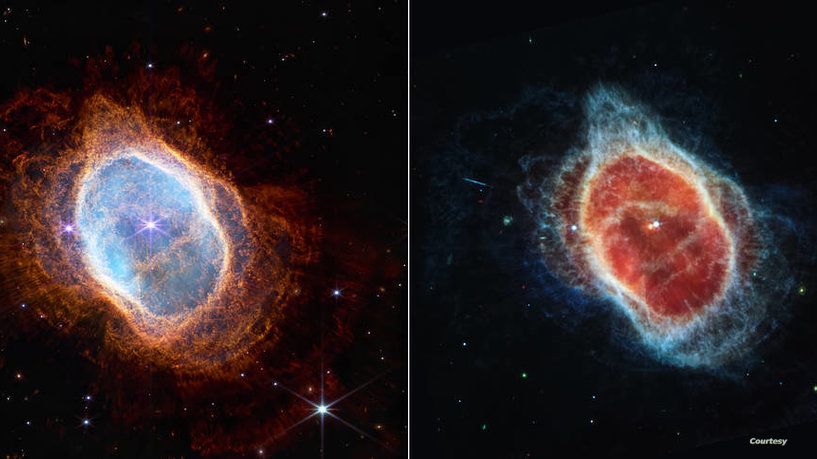
This side-by-side comparison shows observations of the Southern Ring Nebula in near-infrared light, at left, and mid-infrared light, at right, from NASA’s Webb Telescope.
This scene was created by a white dwarf star – the remains of a star like our Sun after it shed its outer layers and stopped burning fuel though nuclear fusion. Those outer layers now form the ejected shells all along this view.
In the Near-Infrared Camera (NIRCam) image, the white dwarf appears to the lower left of the bright, central star, partially hidden by a diffraction spike. The same star appears – but brighter, larger, and redder – in the Mid-Infrared Instrument (MIRI) image. This white dwarf star is cloaked in thick layers of dust, which make it appear larger.
The brighter star in both images hasn’t yet shed its layers. It closely orbits the dimmer white dwarf, helping to distribute what it’s ejected.
Over thousands of years and before it became a white dwarf, the star periodically ejected mass – the visible shells of material. As if on repeat, it contracted, heated up – and then, unable to push out more material, pulsated. Stellar material was sent in all directions – like a rotating sprinkler – and provided the ingredients for this asymmetrical landscape.
Today, the white dwarf is heating up the gas in the inner regions – which appear blue at left and red at right. Both stars are lighting up the outer regions, shown in orange and blue, respectively.
The images look very different because NIRCam and MIRI collect different wavelengths of light. NIRCam observes near-infrared light, which is closer to the visible wavelengths our eyes detect. MIRI goes farther into the infrared, picking up mid-infrared wavelengths. The second star more clearly appears in the MIRI image, because this instrument can see the gleaming dust around it, bringing it more clearly into view.
The stars – and their layers of light – steal more attention in the NIRCam image, while dust pl